120V vs 480V Garage Heaters in 2026: Key Differences
As an Amazon Associate we earn from qualifying purchases. Links on this page are affiliate links.
Choosing the right 120V vs 480V garage heater depends on your power infrastructure. Both units provide electric heating for workshops and garages, but they serve different scale requirements. The Shinic model offers a dual-pack radiant solution for smaller spaces, while the DR Infrared unit delivers high-capacity forced air for large areas. Your existing electrical panel determines which voltage class fits your needs. You must match the heater to your available circuits to ensure safe and effective operation.
Key differences
| Aspect | Shinic 120V Ceiling Radiant Heater 2-Pack | DR Infrared 20KW 3-Phase Unit Heater |
|---|---|---|
| Voltage | 120V | 480V |
| Wattage | 1500W / 750W | 20KW |
| Heating Method | Radiant | Infrared |
| Heat Settings | 5 Settings | not listed |
| Form Factor | Ceiling-Mounted | Unit Heater |
| Room | Garage | not listed |
Which one should you choose?
Choose Shinic 120V Ceiling Radiant Heater 2-Pack if
- You have standard 120V household circuits available.
- You need adjustable heat levels and a built-in light.
- You are heating a smaller garage or workshop area.
Choose DR Infrared 20KW 3-Phase Unit Heater if
- You have access to 480V three-phase industrial power.
- You need to heat a large commercial or industrial space.
- You require uniform air distribution for a big room.
Verdict: The Shinic 120V heater suits typical residential garages where standard outlets exist. The DR Infrared 480V unit is designed for large facilities with industrial power infrastructure. Select the voltage that matches your available electrical supply.
120V vs 480V Garage Heater Specs
Voltage compatibility
The Shinic heater operates on standard 120V power, making it compatible with typical residential outlets. This allows for easy installation in most garages without specialized electrical work. In contrast, the DR Infrared heater requires 480V three-phase power. This high voltage is common in commercial settings but not in standard homes. You must verify your electrical panel supports 480V before considering the DR unit. The Shinic model offers immediate usability for the average homeowner, while the DR unit demands professional electrical infrastructure.
Power output
The Shinic unit provides 1500W of heat, split across two bulbs for flexible settings. This output is sufficient for spot heating in smaller workshops or garages. The DR Infrared heater delivers a massive 20KW of power. This high wattage is designed for large industrial spaces. The difference in output is significant. The Shinic unit is suitable for personal comfort, while the DR unit is built for heating large volumes of air. You need to match the wattage to the size of your space to avoid underheating or overloading circuits.
Heating method
The Shinic heater uses radiant quartz tubes to heat objects and people directly. This method provides instant warmth without needing to heat the entire air volume. The DR Infrared heater also uses infrared technology but includes a fan for uniform air distribution. This combination ensures even heat across a large area. The Shinic model is ideal for targeted warmth at a workbench. The DR unit is better for maintaining a consistent temperature in a vast workshop. Your choice depends on whether you need spot heating or whole-room climate control.
Control features
The Shinic heater features a pull-string switch with five distinct settings. You can adjust between low heat, high heat, light combinations, and off modes manually. The DR Infrared heater specifications do not list a specific control interface. It likely relies on a thermostat or external controller not detailed in the data. The Shinic model offers immediate, tactile control for quick adjustments. The DR unit’s control method is unclear from the provided specs. If you prefer manual, immediate control, the Shinic design is more transparent.
Physical dimensions
The Shinic heater measures 24 inches in height, 11 inches in length, and 15 inches in width. It comes in a 2-pack, offering two units for coverage. The DR Infrared heater is larger, measuring 22 inches in height, 19 inches in length, and 14 inches in width. It weighs 60 pounds, indicating a heavy-duty build. The Shinic unit is lighter and designed for ceiling mounting with adjustable brackets. The DR unit’s substantial weight suggests a robust construction for permanent installation. Consider your mounting capabilities and available space when choosing between these sizes.
Which 120V or 480V heater fits your space
Homeowners with standard outlets and small garages
The Shinic unit runs on 120V, allowing you to plug it into a standard residential outlet without hiring an electrician. Its 1500W radiant heating warms objects directly, which is efficient for smaller workshops. The dual-pack design covers more area, and the built-in halogen light helps you see your tools clearly during evening projects.
Commercial spaces needing high-capacity industrial heating
The DR Infrared heater delivers 20KW of power, making it suitable for large, high-ceilinged commercial garages or workshops. It requires 480V three-phase power, so you must have the proper industrial infrastructure installed. The heavy-duty motor and totally enclosed design ensure long-lasting performance in demanding environments with uniform air distribution.
Users who want adjustable heat and lighting
You get five settings on the Shinic heater, including low and high heat options with or without the halogen work light. This flexibility lets you adjust warmth and visibility based on your current task. The ceiling mount saves floor space, and the 90-degree adjustable head directs radiant heat exactly where you need it most.
Quick picks
| # | Product | Best for | Price |
|---|---|---|---|
| 1 | Shinic 120V Ceiling Radiant Heater 2-Pack | Targeted radiant heat and task lighting | Check price of Shinic 120V Ceiling Radiant Heater 2-Pack on Amazon |
| 2 | DR Infrared 20KW 3-Phase Unit Heater | large spaces with 480V power | Check price of DR Infrared 20KW 3-Phase Unit Heater on Amazon |
The products compared

Shinic 120V Ceiling Radiant Heater 2-Pack
Best for: Targeted radiant heat and task lighting
- Voltage
- 120V (what this guide is about)
- Wattage
- 1500W / 750W
- Mounting Type
- Ceiling Mount
- Heating Method
- Radiant Quartz
- Control Type
- Pull-String Switch
- Room
- Garage, Workshop, Shop
View on Amazon: Shinic 120V Ceiling Radiant Heater 2-Pack Affiliate link
This Shinic unit is a 120V electric garage heater designed for ceiling mounting. It delivers 1500W of radiant heat via dual quartz tubes, with a 750W low setting. The device includes a built-in halogen work light and rotates 90 degrees. It uses a pull-string switch for five modes. This setup suits you if you need direct radiant warmth and visibility in a workshop or garage without installing high-voltage wiring.
Pros
- 120V plug-in power for standard outlets
- 1500W radiant quartz heating for direct warmth
- Built-in halogen work light for visibility
- 90-degree adjustable ceiling mount saves floor space
- ETL Listed with overheat auto-off safety
Cons
- Pull-string switch lacks remote or wall control
- Radiant heat warms objects directly, not the whole room air
- Bulky 24-inch height requires ceiling clearance
Good fit if
- You want instant radiant heat for a specific work area
- You need a 120V unit that plugs into standard outlets
- You require a built-in light for night work
Skip if
- You need whole-room convection heating
- You want smart app or remote control
- You have low ceilings that block rotation
Verdict: Shinic 120V 1500W Ceiling Radiant Heater offers direct radiant warmth and task lighting for garage workspaces. It fits you if you need simple, plug-in heat for a specific zone rather than ambient room heating.
DR Infrared 20KW 3-Phase Unit Heater
Best for: large spaces with 480V power
- Voltage
- 480V (what this guide is about)
- Wattage
- 20KW
- Power Source
- Corded electric
- Heating Method
- Infrared
- Color
- Gray
- Dimensions
- 19 × 14 × 22 inches
View on Amazon: DR Infrared 20KW 3-Phase Unit Heater Affiliate link
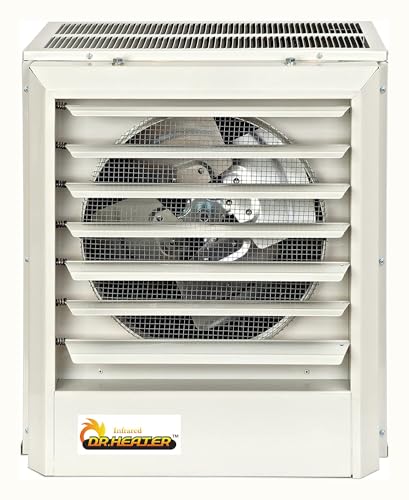
This Dr Infrared unit is a 20KW, 3-phase heater designed for 480V circuits. It measures 19 by 14 by 22 inches and weighs 60 pounds. The gray casing houses an infrared heating element that distributes air uniformly. It features a permanently lubricated, totally enclosed motor with overheat protection. You need a dedicated 480V power source for this high-output device.
Pros
- 20KW output for large spaces
- 3-phase 480V power connection
- Infrared heating method
- Overheat protected motor
- Uniform air distribution
Cons
- Requires 480V electrical supply
- Heavy at 60 pounds
- Large physical footprint
Good fit if
- You have a 480V electrical system
- You need high heat for a large garage
- You prefer infrared heating
Skip if
- You only have 120V outlets
- You need a portable lightweight unit
- You want a small footprint
Verdict: Dr Infrared 20KW 3-Phase Garage Heater is built for heavy-duty commercial or industrial garages with 480V power. It delivers strong infrared heat but requires professional installation and significant mounting space.
Specifications side by side
| Spec | Shinic 120V Ceiling Radiant Heater 2-Pack | DR Infrared 20KW 3-Phase Unit Heater |
|---|---|---|
| Wattage | 1500W / 750W | 20KW |
| Voltage | 120V | 208 to 480-volt |
| Mounting Type | Ceiling Mount | not stated |
| Heating Method | Radiant Quartz | not stated |
| Power Source | not stated | Corded electric |
| Control Type | Pull-String Switch | not stated |
| Room | Garage, Workshop, Shop | not stated |
| Form Factor | Ceiling-Mounted | not stated |
| Color | Black | Gray |
| Size | Large | 19 In |
| Dimensions | 11 × 15 × 24 inches | 19 × 14 × 22 inches |
| Weight | 5.51 pounds | 60 pounds |
| Model | QGW15-602 | DR-P3200 |
Frequently asked questions
Can I plug a 480V garage heater into a standard outlet?
No. The DR Infrared 20KW unit requires 480V three-phase power. You cannot connect it to a standard residential outlet. This voltage is typically found in commercial or industrial settings. You must have professional electrical infrastructure installed to use this heater safely.
Does a 120V heater need special wiring?
No. The Shinic 120V Ceiling Radiant Heater uses standard 120V power. It fits into typical residential outlets. You do not need specialized electrical work. This makes it suitable for most home garages without upgrading your electrical panel.
Which heater is better for a large commercial garage?
The DR Infrared 20KW unit is better for large spaces. It delivers 20KW of heat using 480V power. It is built for heavy-duty commercial or industrial garages. The Shinic model is limited to 1500W and targets specific zones rather than whole rooms.
How much space does the DR Infrared heater take?
The DR Infrared heater measures 22 inches high, 19 inches long, and 14 inches wide. It weighs 60 pounds. You need significant mounting space. The unit is designed for ceiling or wall mounting in areas with high ceilings.
Does the Shinic heater provide ambient room heat?
It provides targeted radiant warmth. The Shinic unit is designed for specific zones rather than ambient room heating. It offers direct radiant warmth and task lighting. This is ideal for garage workspaces where you need heat in a specific area.
What is the difference in heating method between these two?
The Shinic heater uses radiant heat. The DR Infrared unit also uses infrared heating. However, the DR unit is a 20KW unit heater for large spaces. The Shinic is a 1500W ceiling-mounted solution for smaller, targeted areas.
Can I install the 480V heater myself?
Professional installation is required. The DR Infrared heater needs 480V three-phase power. This voltage is not available in standard homes. You must hire a qualified electrician to install the necessary power lines and connect the unit safely.