DREO vs Vornado: Fans Compared by Specs
As an Amazon Associate we earn from qualifying purchases. Links on this page are affiliate links.
You are comparing a DREO vs vornado fan choice that serves different cooling needs. The DREO unit is a tower fan designed for indoor room circulation, while the Vornado is a window fan built for ventilation and air exchange. Both devices offer multiple speed settings to adjust airflow intensity. However, their form factors and installation methods differ significantly. You must decide between portable indoor cooling or fixed window ventilation based on your specific space and airflow requirements.
Key differences
| Aspect | DREO 42-Inch DC Motor Tower Fan | Vornado TRANSOM Low-Profile Window Fan |
|---|---|---|
| Form Factor | Tower | Window |
| Speed Settings | 9 | 4 |
| Control Type | Not listed | Remote control |
| Oscillation | 90° | Not listed |
| Airflow Reach | 36ft | Not listed |
Which one should you choose?
Choose DREO 42-Inch DC Motor Tower Fan if
- You want a portable tower fan for indoor bedroom or office use.
- You prefer more speed settings and oscillation for targeted cooling.
- You need a high-velocity fan that reaches up to 36ft.
Choose Vornado TRANSOM Low-Profile Window Fan if
- You need a window fan for ventilation and air exchange.
- You want remote control operation for easy adjustment.
- You are installing a fan in a single or double-hung window.
Verdict: The DREO tower fan is the better choice for general indoor cooling and air circulation within a room. The Vornado window fan is the correct tool if you need to exchange indoor air with the outdoors. Your decision should depend on whether you prioritize cooling comfort or ventilation.
DREO Tower vs Vornado Window Fan Specs
Form Factor
The DREO 42-Inch DC Motor Tower Fan is a freestanding unit designed for indoor room circulation. It stands 41.7 inches tall with a footprint of 13 by 13 inches, making it suitable for bedrooms or home offices. The Vornado TRANSOM is a low-profile window fan, measuring only 7.2 inches tall. It installs directly into a window frame, requiring a width between 26 and 40 inches. This design allows it to pull in fresh outdoor air or exhaust stale indoor air. You must choose between a standalone tower for general cooling or a window-mounted unit for ventilation and air exchange.
Airflow Power
Airflow performance differs significantly between these two devices. The DREO tower fan uses a DC motor to deliver a maximum airflow of 28 feet per second and 1473 CFM. This high velocity is intended to refresh living spaces quickly. The Vornado TRANSOM window fan does not list specific CFM or velocity figures in its published specifications. It focuses on reversing airflow direction rather than maximizing internal circulation speed. If you need measurable high-velocity air movement within a room, the DREO provides clear data. For exchanging air with the outdoors, the Vornado serves a different purpose where raw speed metrics are less relevant.
Speed Settings
Control over airflow intensity varies by the number of available settings. The DREO tower fan offers 9 distinct speed settings. It also includes 4 smart modes: Standard, Natural, Sleep, and Turbo. This allows for fine-tuned adjustments from a gentle breeze to powerful cooling. The Vornado TRANSOM window fan provides 4 speed settings. It also features auto temperature control to adjust operation based on ambient heat. While the Vornado offers smart automation, the DREO gives you more manual granularity. You can choose between broad automated control or precise manual adjustment based on your preference.
Control Features
User interface options differ between the two brands. The Vornado TRANSOM includes a remote control for operation. This allows you to change settings without getting up, which is convenient for window installations. The DREO tower fan specifications do not mention a remote control. It relies on direct panel interaction. However, the DREO includes a display that automatically dims after 30 seconds for nighttime use. It also features a 12-hour timer for scheduled operation. If you prefer hands-free control via remote, the Vornado has the advantage. If you value automatic display dimming and timers, the DREO offers those features.
Oscillation
Air distribution method is another key difference. The DREO tower fan supports 90-degree wide-angle oscillation. This helps distribute the 28 ft/s breeze across the room, reducing hot spots. The Vornado TRANSOM window fan does not list oscillation capabilities in its specs. It is designed to be installed in a fixed horizontal position. It cannot oscillate to spread air within a room. Instead, it moves air in or out of the window opening. You need oscillation for circulating air inside a space. You need fixed ventilation for exchanging indoor air with the outdoors.
Which fan fits your room best
You want quiet indoor circulation
The DREO tower fan uses a DC motor for whisper-quiet operation. Its 90-degree oscillation covers wide areas, while the auto-dimming display and 12-hour timer help you sleep. It delivers 1473 CFM of airflow to keep your bedroom cool without noise.
You need fresh outdoor air
The Vornado TRANSOM is a window fan designed for ventilation. It reverses electronically to exhaust stale air or intake fresh air. The remote control and auto temperature settings let you manage airflow easily. It fits windows 26 to 40 inches wide.
You prefer adjustable indoor breeze
This DREO unit offers 9 speeds and 4 smart modes for tailored comfort. The high velocity of 28 ft/s provides instant relief. Its removable rear grille makes cleaning simple. You get flexible airflow settings for different moments, from gentle breeze to turbo power.
The products compared

DREO 42-Inch DC Motor Tower Fan
Best for: Bedrooms needing quiet, high-velocity air circulation
- Form Factor
- Tower
- Fan Size
- 42"
- Speed Settings
- 9
- Oscillation Angle
- 90°
- Maximum Airflow
- 1473 CFM, 28 ft/s
- Features
- Oscillation, Timer
View on Amazon: DREO 42-Inch DC Motor Tower Fan Affiliate link
This DREO tower fan uses a 1580RPM DC motor to deliver up to 28 ft/s wind speed and 1473 CFM airflow. It offers 9 speed settings and 4 smart modes for tailored comfort. The 42-inch height and 90-degree oscillation cover large areas. It runs quietly with an auto-dimming display and a 12-hour timer. This unit suits bedrooms or home offices where quiet, steady air circulation is your priority.
Pros
- High velocity of 28 ft/s with 1473 CFM airflow
- 9 speed settings and 4 smart modes for customization
- DC motor designed for whisper-quiet operation
- 90-degree wide-angle oscillation reaches every corner
- 12-hour timer and auto-dimming display for night use
Cons
- 90-degree oscillation is narrower than 120-degree or 360-degree alternatives
- No remote control listed in specifications
- No smart app or voice control integration mentioned
Good fit if
- You need high airflow in a bedroom or office
- You prefer quiet operation with a DC motor
- You want multiple speed and mode settings
Skip if
- You require remote control functionality
- You need wide-angle oscillation beyond 90 degrees
- You want smart app connectivity
Verdict: DREO Tower Fan 42 inch 9 Speeds delivers strong, quiet airflow with customizable settings. It fits buyers who prioritize performance and noise reduction over remote or smart features.
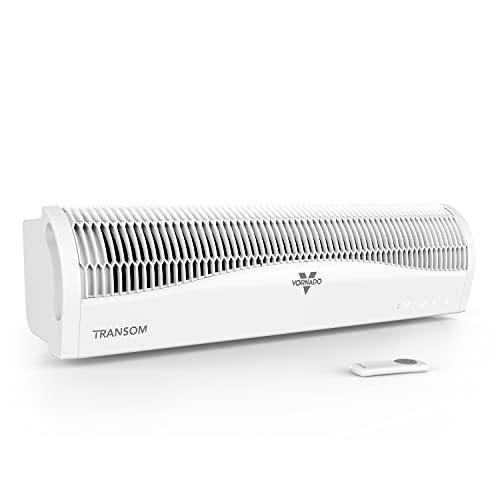
Vornado TRANSOM Low-Profile Window Fan
Best for: horizontal window ventilation with remote control
- Form Factor
- Window
- Speed Settings
- 4
- Control Type
- Remote control
- Color
- White
- Number of Speeds
- 4 Speeds
- Dimensions
- 5.7 × 26 × 7.2 inches
View on Amazon: Vornado TRANSOM Low-Profile Window Fan Affiliate link
This Vornado window fan offers reversible airflow for intake or exhaust. It features four speed settings and an auto temperature control system. The unit includes a remote control for easy adjustment. Its low-profile design fits single- or double-hung windows between 26 and 40 inches wide. Weighing 8.3 pounds, it provides whole-room ventilation. This model suits users seeking precise air exchange control in standard window frames.
Pros
- Electronically reversible for intake or exhaust modes
- Includes remote control for operation
- Auto temperature control feature
- Fits windows 26 to 40 inches wide
Cons
- Only four speed settings
- Horizontal installation only
- No vertical mounting option
Good fit if
- You need reversible airflow for ventilation
- You have a standard horizontal window
- You prefer remote control operation
Skip if
- You require more than four speeds
- You need vertical window installation
- You want smart home integration
Verdict: Vornado Window Fan Remote Control is a practical solution for horizontal windows needing reversible airflow. It fits buyers who want remote control and auto temperature management.
Specifications side by side
| Spec | DREO 42-Inch DC Motor Tower Fan | Vornado TRANSOM Low-Profile Window Fan |
|---|---|---|
| Form Factor | Tower | Window |
| Fan Size | 42" | not stated |
| Speed Settings | 9 | 4 |
| Oscillation Angle | 90° | not stated |
| Control Type | not stated | Remote control |
| Maximum Airflow | 1473 CFM, 28 ft/s | not stated |
| Features | Oscillation, Timer | Remote Control |
| Room | Bedroom, Office | not stated |
| Color | Black | White |
| Size | 42 Inch | Whole Room |
| Number of Speeds | not stated | 4 Speeds |
| Dimensions | 41.7 × 13 × 13 inches | 5.7 × 26 × 7.2 inches |
| Weight | 9.79 pounds | 8.3 pounds |
| Model | DR-HTF018 | FA1-0136-43 |
Frequently asked questions
Is the DREO tower fan better for bedrooms than the Vornado window fan?
Yes, if you need quiet indoor circulation. The DREO 42-Inch DC Motor Tower Fan is designed for bedrooms and delivers strong, quiet airflow with customizable settings. The Vornado unit is a window fan built for ventilation and air exchange, making it less suitable for quiet sleeping environments.
Does the Vornado fan have remote control capabilities?
Yes, the Vornado TRANSOM Low-Profile Window Fan includes remote control functionality. This feature allows you to manage horizontal window ventilation and auto temperature management without leaving your seat. The DREO tower fan does not list remote control in its specifications.
What is the size difference between the DREO and Vornado fans?
The DREO fan is a 42-inch tower unit measuring 41.7 inches in length. The Vornado window fan is smaller, with a length of 5.7 inches and a width of 26 inches. The DREO model weighs 9.79 pounds, while the Vornado weighs 8.3 pounds.
Which fan is better for whole room ventilation?
The Vornado TRANSOM is specified for whole room ventilation. It is designed for horizontal window ventilation with reversible airflow. The DREO unit is a tower fan focused on indoor room circulation rather than exchanging air with the outdoors.
How many speed settings does each fan offer?
The Vornado TRANSOM offers 4 speed settings. The DREO 42-Inch DC Motor Tower Fan provides 9 speeds. Both units allow you to adjust airflow intensity to match your comfort needs, with the DREO offering more granular control.
Can the Vornado fan be used for heating or cooling?
The Vornado TRANSOM supports auto temperature management for ventilation. It is designed for horizontal window ventilation. The DREO tower fan is a cooling device for indoor air circulation. Neither product is described as a heater in the provided specifications.
Which fan has a more compact footprint?
The Vornado window fan has a more compact footprint for installation. It measures 26 inches wide and 5.7 inches long. The DREO tower fan has a square footprint of 13 by 13 inches but stands 41.7 inches tall, requiring more vertical space.
Is the DREO fan suitable for large rooms?
The DREO tower fan is best for bedrooms needing quiet, high-velocity air circulation. It is not specified for whole room ventilation like the Vornado. The Vornado unit is rated for whole room ventilation, making it potentially more effective for larger spaces requiring air exchange.