Propane vs Natural Gas Garage Heaters in 2026: Key Differences
As an Amazon Associate we earn from qualifying purchases. Links on this page are affiliate links.
Choosing between a propane vs natural gas garage heater depends on your fuel access and space needs. Both Mr. Heater models provide reliable warmth for workshops, barns, or garages. The first unit is a portable propane convection heater, while the second is a ceiling-mounted forced-air unit that works with either propane or natural gas. You should compare their heating methods, coverage areas, and mounting requirements to decide which fits your garage layout and fuel supply best.
Key differences
| Aspect | Mr. Heater 80,000 BTU Portable Propane Convection Heater | Mr. Heater 50,000 BTU Ceiling Forced-Air Heater |
|---|---|---|
| Power Source | Propane | Propane or Natural Gas |
| Heating Method | Convection | Forced Air |
| Heat Output | 30k to 80k BTU/HR | 50,000 BTU |
| Coverage Area | Up to 2,000 sq ft | Up to 1,667 sq ft |
| Form Factor | Portable | Ceiling Mount |
Which one should you choose?
Choose Mr. Heater 80,000 BTU Portable Propane Convection Heater if
- You need a portable heater that you can move between different locations.
- You want adjustable heat settings ranging from 30,000 to 80,000 BTUs.
- You prefer convection heating for a 360-degree warm air distribution.
Choose Mr. Heater 50,000 BTU Ceiling Forced-Air Heater if
- You have a natural gas line available and want the flexibility to use it.
- You need a permanent, space-saving ceiling-mounted installation.
- You want compatibility with standard 24-volt or Wi-Fi thermostats.
Verdict: Choose the portable propane convection heater if you value flexibility and adjustable heat output for various spaces. Select the ceiling-mounted forced-air unit if you have a fixed natural gas connection and want a permanent, space-saving solution. Both units offer robust safety features and cover typical garage sizes effectively.
Propane vs Natural Gas Heater Specs
Heating Method
The Mr. Heater 80,000 BTU Portable Propane Convection Heater uses convection to warm the air in your space. It features a cylindrical chamber that provides 360-degree heating, allowing warm air to circulate naturally. In contrast, the Mr. Heater 50,000 BTU Ceiling Forced-Air Unit Heater relies on forced air. This method actively pushes heated air out, which can distribute warmth more quickly in large, open areas like workshops or barns. Your choice depends on whether you prefer gentle, even convection or rapid, directed airflow for your garage or workspace environment.
Heat Output
Heat output varies significantly between these two units. The portable propane model offers a range of 30,000 to 80,000 BTUs, with high and low settings to adjust intensity. This flexibility allows you to manage energy use based on the day's temperature. The ceiling-mounted unit provides a fixed 50,000 BTU output. While it cannot be adjusted, this consistent output is designed to heat up to 1,667 square feet, covering approximately a three-car garage. If you need variable heat levels, the portable option is more adaptable.
Coverage Area
Coverage area determines how much space each heater can effectively warm. The portable propane heater is rated to heat up to 2,000 square feet. This makes it suitable for larger workshops or open-plan garages. The ceiling-mounted forced-air unit covers up to 1,667 square feet. While still substantial, this is slightly less than the portable model's maximum capacity. For smaller spaces like a standard two-car garage, both are sufficient. However, if you have a larger area exceeding 1,667 square feet, the portable propane heater provides the necessary coverage.
Form Factor
Installation and placement differ greatly between these products. The portable propane heater is a standalone unit weighing 13.4 pounds. It measures 15.9 inches wide, 16.7 inches long, and 21.8 inches high. You can move it anywhere with proper ventilation. The ceiling-mounted unit weighs 60.3 pounds and requires permanent installation. It needs a minimum 10-foot ceiling height and 8 feet of clearance from the floor. This fixed position saves floor space but requires professional setup and specific structural requirements in your garage or workshop.
Safety Features
Both heaters include essential safety mechanisms to protect your space. The portable propane model features a thermo-electric safety valve that shuts off gas flow if the flame goes out. This prevents gas leaks in well-ventilated areas like construction sites. The ceiling-mounted unit includes a high-temperature safety shut-off switch and a gas safety shut-off flame sensor. These features monitor operation closely to prevent overheating or gas accumulation. Both designs prioritize safety, but the portable unit relies on a single valve while the ceiling unit uses multiple sensors for comprehensive protection.
Compatibility
Thermostat compatibility affects how you control temperature. The ceiling-mounted forced-air unit is compatible with standard 24-volt thermostats or new Wi-Fi enabled thermostats, which are sold separately. This allows for automated temperature control and remote management via smart home systems. The portable propane heater does not list thermostat compatibility in its specifications. It operates via manual high and low heat settings. If you want precise, automated climate control, the ceiling-mounted unit offers superior integration with modern thermostat systems.
Which garage heater fits your space
You need portable heat for small shops
This unit is lightweight at 13.4 pounds and compact at 15.9 inches wide. You can move it easily between workspaces. The 80,000 BTU output heats up to 2,000 square feet quickly. Its convection design circulates warm air naturally. You also get adjustable settings from 30,000 to 80,000 BTUs for precise control.
You want fixed heating for a garage
This heater mounts to your ceiling, saving floor space in your workshop. It delivers 50,000 BTUs of forced-air heat for areas up to 1,667 square feet. The unit works with both propane and natural gas lines. You can connect it to a standard 24-volt thermostat. The safety features include a high-temperature shut-off and flame sensor.
You need versatile fuel options
You can choose between propane or natural gas for this ceiling-mounted unit. It provides consistent forced-air heating for larger spaces like a three-car garage. The design requires a minimum 10-foot ceiling height. You benefit from a gas safety shut-off flame sensor. This flexibility allows you to use the fuel source most available in your garage.
You prioritize quick and even warmth
The cylindrical chamber provides 360-degree convection heating for rapid warmth. You get high and low settings to adjust the heat intensity. The unit heats up to 2,000 square feet effectively. Its portable form factor means you can place it anywhere. The thermo-electric safety valve adds peace of mind by shutting off gas if the flame goes out.
Quick picks
| # | Product | Best for | Price |
|---|---|---|---|
| 1 | Mr. Heater 80,000 BTU Portable Propane Convection Heater | ventilated workshops needing high BTU output | Check price of Mr. Heater 80,000 BTU Portable Propane Convection Heater on Amazon |
| 2 | Mr. Heater 50,000 BTU Ceiling Forced-Air Heater | High-ceiling garages needing fixed high-output heat | Check price of Mr. Heater 50,000 BTU Ceiling Forced-Air Heater on Amazon |
The products compared
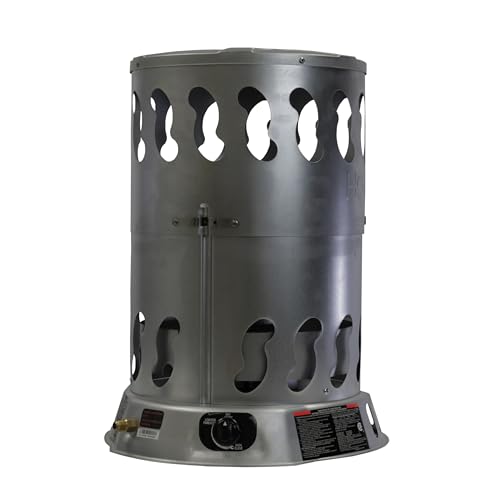
Mr. Heater 80,000 BTU Portable Propane Convection Heater
Best for: ventilated workshops needing high BTU output
- Power Source
- Propane (what this guide is about)
- Heat Output
- 80,000 BTU
- Heating Method
- Convection
- Coverage Area
- 2,000 sq ft
- Form Factor
- Portable
- Color
- Silver
View on Amazon: Mr. Heater 80,000 BTU Portable Propane Convection Heater Affiliate link
This portable propane convection heater delivers 30,000 to 80,000 BTUs of heat. It features a cylindrical design for 360-degree warming and covers up to 2,000 square feet. The unit includes high and low settings and a thermo-electric safety valve. You will appreciate its lightweight 13.4-pound build for moving it around. It suits well-ventilated spaces like workshops or barns where you need reliable, fuel-efficient warmth.
Pros
- High output of 80,000 BTUs on the max setting
- 360-degree convection heating via cylindrical chamber
- Covers areas up to 2,000 square feet
- Thermo-electric safety valve shuts off gas if flame goes out
- Lightweight at 13.4 pounds for easy portability
Cons
- Limited to propane fuel source only
- No adjustable thermostat for precise temperature control
- Requires manual ignition and monitoring
Good fit if
- You need high heat for a 2,000 sq ft space
- You work in well-ventilated areas like workshops or barns
- You want a portable unit under 14 pounds
Skip if
- You require natural gas connectivity
- You need a thermostat for automatic temperature regulation
- You are sealing the space tightly without ventilation
Verdict: Mr. Heater 80k BTU Propane Convection Heater is a solid choice for users who need powerful, portable heat in large, ventilated areas like garages or workshops. It fits those who prioritize raw output and safety features over precise temperature control.

Mr. Heater 50,000 BTU Ceiling Forced-Air Heater
Best for: High-ceiling garages needing fixed high-output heat
- Power Source
- Natural Gas (what this guide is about)
- Heat Output
- 50,000 BTU
- Mounting Type
- Ceiling Mount
- Heating Method
- Forced Air
- Coverage Area
- Up to 1,667 sq ft
- Color
- Black
View on Amazon: Mr. Heater 50,000 BTU Ceiling Forced-Air Heater Affiliate link
This ceiling-mounted unit delivers 50,000 BTUs of forced-air heat for spaces up to 1,667 square feet. It works with propane or natural gas and fits 3-car garages. The low-profile design requires a 10-foot ceiling and 8-foot floor clearance. You can connect it to standard 24-volt or Wi-Fi thermostats for automated control. It includes high-temperature and flame safety shut-offs for secure operation.
Pros
- 50,000 BTU heat output for up to 1,667 sq ft
- Dual compatibility with propane or natural gas
- Ceiling-mounted forced-air design saves floor space
- Compatible with Wi-Fi enabled thermostats
Cons
- Requires minimum 10 ft. ceiling height
- Needs 8 ft. clearance from base to floor
- Heavy at 60.3 pounds for installation
Good fit if
- You have a 3-car garage or large workshop
- You need a ceiling-mounted solution to save floor space
- You want to control heating via a Wi-Fi thermostat
Skip if
- You have ceilings lower than 10 feet
- You need a portable unit for temporary heating
- You cannot accommodate the 29-inch width and 60-pound weight
Verdict: Mr. Heater 50,000 BTU Forced-Air is a robust ceiling-mounted heater for large, high-ceilinged spaces like 3-car garages. It suits users who want fixed, high-output heat and smart thermostat integration.
Specifications side by side
| Spec | Mr. Heater 80,000 BTU Portable Propane Convection Heater | Mr. Heater 50,000 BTU Ceiling Forced-Air Heater |
|---|---|---|
| Heat Output | 80,000 BTU | 50,000 BTU |
| Mounting Type | not stated | Ceiling Mount |
| Heating Method | Convection | Forced Air |
| Coverage Area | 2,000 sq ft | Up to 1,667 sq ft |
| Power Source | Propane | Propane or Natural Gas |
| Form Factor | Portable | not stated |
| Color | Silver | Black |
| Dimensions | 16.7 × 15.9 × 21.8 inches | 15 × 29 × 26 inches |
| Weight | 13.4 pounds | 60.3 pounds |
| Size | 30k to 80k BTU/HR | 50000 |
| Model | F270490 | F260550 |
Frequently asked questions
Can I use a propane heater in a garage without a gas line?
Yes, you can use a propane heater if your garage lacks a natural gas line. The Mr. Heater 80,000 BTU Portable Propane Convection Heater runs on propane tanks. This makes it ideal for spaces without fixed fuel infrastructure. You simply connect a standard tank to enjoy portable, high-output heat anywhere.
Is a natural gas heater better for permanent garage heating?
A natural gas heater is often better for permanent setups because it connects directly to your home’s fuel supply. The Mr. Heater 50,000 BTU Ceiling Forced-Air Heater mounts to your ceiling. It provides fixed, continuous heat without needing tank refills. This suits users who want a permanent solution for large spaces.
Which heater is lighter and easier to move?
The portable propane model is significantly lighter and easier to move. It weighs only 13.4 pounds and measures 15.9 inches wide. You can carry it between workspaces easily. In contrast, the natural gas ceiling unit weighs 60.3 pounds and is designed for fixed installation, making it unsuitable for frequent relocation.
Does the propane heater use convection or forced air?
The top-rated propane heater uses convection heating. It features a cylindrical chamber that warms air, which then circulates naturally around your space. This method provides even, 360-degree warmth. It does not use fans to blow air, relying instead on natural air movement to distribute heat throughout your garage or workshop.
What is the maximum BTU output for these garage heaters?
The portable propane heater offers up to 80,000 BTU per hour. This high output allows it to heat large areas quickly. The ceiling-mounted natural gas unit provides 50,000 BTU. Both deliver substantial warmth, but the propane model has a higher peak output, making it suitable for larger, poorly insulated spaces.
Do I need to mount the natural gas heater?
Yes, the natural gas heater is designed for ceiling mounting. It is a fixed unit that requires installation into your garage structure. This frees up floor space and directs heat downward via forced air. You cannot move it easily after installation, so ensure your ceiling can support its 60.3-pound weight.
Which heater is better for a high-ceiling garage?
The ceiling-mounted natural gas heater is better for high-ceiling garages. Its forced-air design pushes warm air down into the working area. This overcomes the tendency of heat to rise in tall spaces. The portable propane unit relies on convection, which may take longer to warm large volumes of air in high-ceiling environments.